
Every 15 August, the world’s largest democracy stops for a morning. Close to a billion registered voters, twenty-two scheduled languages, twenty-eight states that do not agree on very much — and for a few hours they all watch the same flag go up. Then the country does something it does better than almost anywhere else: it goes home and puts on a film. Somewhere in that afternoon, in a very large number of living rooms, one of the Indian patriotic movies that folks here have been rewatching for decades starts playing, and someone in the room mouths the dialogue before the actor gets to it.
I have been watching these films for the better part of twenty years, and I have watched almost all of them from a long way outside the country. That started as an accident — a subtitled disc a colleague pressed on me, then a festival screening of Lagaan in a room where perhaps six people spoke Hindi — and turned into a habit I have never shaken.
Distance does odd things to a genre like this. It strips out the reflex. When a crowd around you rises for a national anthem you didn’t grow up with, you notice the filmmaking instead of the feeling, and the good ones survive that scrutiny remarkably well.
This is a list of the ones that survive it. Twenty-three films, across seven languages, spanning 1964 to 2024, every one of them checked for where you can actually watch it in India as of 14 August 2026. Some are the obvious canon. Several are films that even devoted viewers keep missing, which is a shame, because two or three of them are better than the blockbusters that buried them.
Indian patriotic movies about the freedom struggle
1. Gandhi (1982) — English/Hindi · Dir. Richard Attenborough

Watch it for: the one film on this list that will explain the whole century to someone who knows nothing.
Richard Attenborough spent eighteen years trying to get this made, starting from a 1962 meeting and a biography he could not put down. What he eventually delivered is a three-hour argument that non-violence is a strategy rather than a temperament — and it is still the most persuasive dramatisation of that idea anyone has managed. There is a reason it took eight Academy Awards from eleven nominations, including Best Picture and Best Actor. Ben Kingsley does not perform Gandhi so much as recede into him.
The production facts remain astonishing. The funeral sequence used a reported 300,000 extras, still cited by Guinness World Records as the most in any film. India’s own National Film Development Corporation put in the first $10 million, which unlocked everything else — this was a co-production, not a foreign gaze imposed from outside. And Bhanu Athaiya’s costume-design win made her the first Indian to hold an Academy Award, four decades before the country’s next one. The scale of the crew and cast is genuinely worth scrolling through on the film’s TMDB page.
Where to watch in India: JioHotstar or EPIC ON — current options.
2. Lagaan: Once Upon a Time in India (2001) — Hindi · Dir. Ashutosh Gowariker

Watch it for: the single most entertaining anti-colonial film ever made, and the one where the cricket is the point.
A village in 1893 is told it can skip three years of punitive tax if it beats the garrison at their own game. That is the whole premise, and Gowariker stretches it across three hours and forty-four minutes without a slack stretch in it. It became only the third Indian film nominated for the Best Foreign Language Film Oscar, after Mother India and Salaam Bombay! — and, as of now, the last.
The making of it is nearly as good a story. The unit built a period hamlet at Kunariya near Bhuj, in Kutch, chosen precisely because it had no electricity, no phone lines and no cars. Villagers constructed the set four months ahead using traditional methods and lent most of the 19th-century props.
Temperatures swung between freezing and fifty degrees; Gowariker slipped a disc and lost a month. Fifteen foreign actors were cast, with Rachel Shelley and Paul Blackthorne doing far more than the genre usually asks of its British roles — the credits list is a good record of how large that ensemble really was. The film turned 25 this June and returned to Indian cinemas for a three-day run, which is the only place I would now choose to see it.
Where to watch in India: currently between streaming homes — its Netflix India licence lapsed and has not been replaced. Check live availability before you plan an evening around it.
3. The Legend of Bhagat Singh (2002) — Hindi · Dir. Rajkumar Santoshi

Watch it for: the argument Gandhi deliberately leaves out.
If Attenborough’s film is the case for non-violence, this is the rebuttal, made with real intellectual seriousness. Santoshi refuses to reduce Bhagat Singh to a hot-headed young man with a pistol; he takes the socialism and the atheism seriously, and lets the courtroom scenes carry the weight the action scenes usually would. Ajay Devgn won the National Film Award for Best Actor, and the film took Best Feature Film in Hindi alongside it.
It also has one of A.R. Rahman’s least-discussed great scores — his settings of “Mera Rang De Basanti” and “Sarfaroshi Ki Tamanna” are the versions most Indians now hear in their heads. The film’s commercial fate was brutal and instructive: three Bhagat Singh films arrived within days of each other in 2002, split the audience, and all of them lost money. The best of the three is the one you can still watch, and the full cast and crew shows how much talent was quietly assembled for it.
Where to watch in India: Prime Video, or free with ads on MX Player and ShemarooMe — see all options.
4. Sardar Udham (2021) — Hindi · Dir. Shoojit Sircar

Watch it for: the most formally ambitious film in the modern canon, and the last twenty-five minutes.
Udham Singh waited twenty-one years to kill Michael O’Dwyer in a London hall. Sircar structures the film around that patience rather than the act, and then — in a choice I still find remarkable — saves the Jallianwala Bagh massacre for the final movement, so that you spend the whole film not quite understanding the man and then, suddenly, understanding him completely. Avik Mukhopadhyay’s photography of that sequence is unbearable in the way it should be.
Vicky Kaushal has called it the hardest role he has taken; the massacre was recreated on constructed sets in Punjab because filming at the site was not permitted, and he has described the shoot as emotionally numbing.
The production ran six to seven months across Russia, India, the UK and Ireland. It won five National Film Awards including Best Feature Film in Hindi — and was still passed over as India’s Oscar submission, a decision that generated a good deal of argument at the time.
Shantanu Moitra’s score is instrumental throughout, no songs, which for a Hindi film of this budget is its own kind of statement. The international ensemble is listed in full if you want to see how much of the cast was British.
Where to watch in India: Prime Video, or free with ads on MX Player — current options.
5. Chittagong (2012) — Hindi · Dir. Bedabrata Pain ★ underrated

Watch it for: the one film on this list almost nobody has seen, told by the most unlikely director in Indian cinema.
Bedabrata Pain spent twenty years at NASA’s Jet Propulsion Laboratory and co-invented the CMOS active-pixel sensor — the technology in the camera on your phone. Then he left, and made this. It tells the 1930 Chittagong armoury raid, in which a schoolteacher named Surya Sen led a group of teenagers against the British in what is now Bangladesh, and it tells it from the point of view of a boy who was fourteen at the time.
That perspective is what makes it. The raid is not staged as triumph; it is staged as children discovering what they have done. Manoj Bajpayee plays Masterda with a schoolteacher’s stoop. The supporting bench is extraordinary in hindsight — Nawazuddin Siddiqui, Rajkummar Rao and Jaideep Ahlawat, all before any of them were famous, which the cast page makes almost comic to look at now. Shankar–Ehsaan–Loy scored it, Prasoon Joshi wrote the lyrics, and it won the National Film Award for Best Debut Film of a Director. It grossed about ₹31 lakh. Find it.
Where to watch in India: rental only, on Prime Video (₹50) or Apple TV — rental links.
6. RRR (2022) — Telugu · Dir. S.S. Rajamouli

Watch it for: the moment the genre stopped apologising for being enormous.
Rajamouli takes two real revolutionaries — Komaram Bheem and Alluri Sitarama Raju — who never met, and imagines what would have happened if they had. It is not history and does not pretend to be; it is myth-making at ₹550 crore, and on its own terms it is close to flawless. I watched it with a crowd who did not know a word of Telugu and the entire room was gone by the interval.
“Naatu Naatu” won Best Original Song at the 95th Academy Awards, the first song from an Asian film to take that category and the first Oscar won by an Indian feature. The Golden Globe came first. The film grossed somewhere north of ₹1,300 crore worldwide.
What tends to get lost in the awards conversation is how carefully constructed the friendship at its centre is — Rajamouli spends an hour building it precisely so the second half can break it. N.T. Rama Rao Jr. and Ram Charan are both doing more acting than the choreography suggests, and the credits are worth a look for the sheer size of the technical crew.
Where to watch in India: Netflix or ZEE5 — current options.
7. Sye Raa Narasimha Reddy (2019) — Telugu · Dir. Surender Reddy
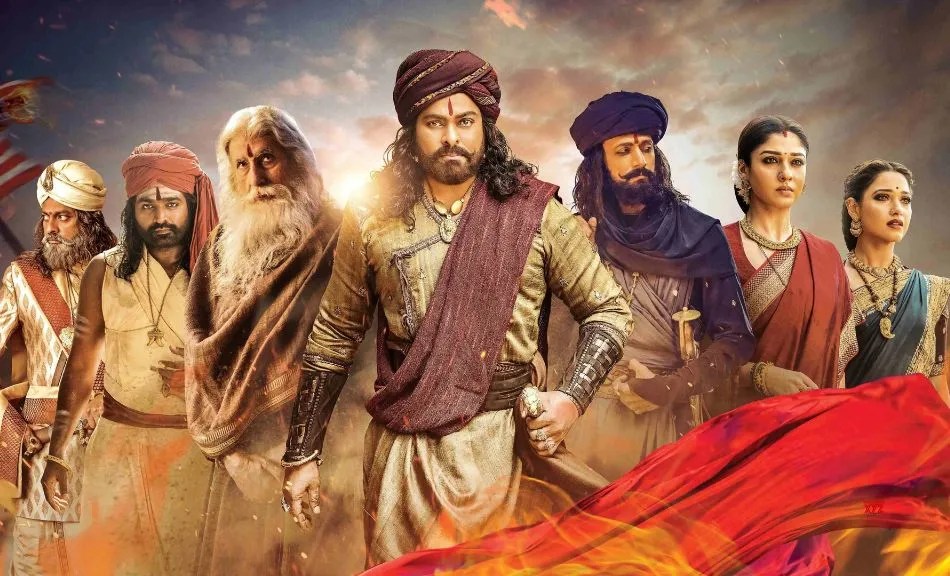
Watch it for: a rebellion that happened eleven years before the one everyone knows about.
Uyyalawada Narasimha Reddy took up arms against the East India Company in Rayalaseema in 1846 — over a decade before 1857. That alone makes the film worth two and a half hours, because the standard narrative of Indian resistance simply does not have room for him. Chiranjeevi, in his 151st film, plays him as granite.
Be clear-eyed about it: historians have pushed back on the framing, noting that Reddy’s revolt was substantially about defending his own rights and revenues against Company confiscation rather than a nationalist movement in the later sense.
The film flattens that. What it does deliver is spectacle at ₹200–300 crore, a supporting cast that reads like a pan-Indian summit — Sudeep, Vijay Sethupathi, Nayanthara, Tamannaah Bhatia, Anushka Shetty as Rani Lakshmibai, and Amitabh Bachchan making his Telugu debut — and R. Rathnavelu’s cinematography, which is genuinely beautiful. The full ensemble explains how it opened to ₹81.4 crore in a day.
Where to watch in India: Prime Video — current options.
8. Upkar (1967) — Hindi · Dir. Manoj Kumar

Watch it for: the film that wrote the rulebook, and a song you will hear at every flag-hoisting this month.
Prime Minister Lal Bahadur Shastri personally suggested to Manoj Kumar that he build a film around the slogan Jai Jawan Jai Kisan — hail the soldier, hail the farmer. Kumar, then only an actor, directed it himself. The result was the highest-grossing Indian film of 1967, seven Filmfare Awards including Best Film and Best Director, and the National Film Award for Second Best Feature Film.
It also fixed the template: two brothers, one to the fields and one to the front, the 1965 war as backdrop, and a moral architecture so clean it borders on the didactic. Modern eyes will find it broad. Watch it anyway, because “Mere Desh Ki Dharti” — Kalyanji-Anandji’s tune, Gulshan Bawra’s words — is still the song that plays over every Independence Day montage on Indian television, and you cannot properly hear the last fifty years of this genre until you have heard where it started. Kumar died in 2025; the cast list is a roll-call of an era, with Pran, Asha Parekh and Kamini Kaushal all at full stretch.
Where to watch in India: ZEE5, free with ads — watch options.
Soldiers, borders, and what the medal actually costs
9. Haqeeqat (1964) — Hindi · Dir. Chetan Anand ★ underrated

Watch it for: the most honest war film India has made, about the war India lost.
Two years after the 1962 defeat to China, Chetan Anand made a film about it that does not flinch. Built around the Battle of Rezang La and a fictionalised account of 5 JAT in Ladakh, it is a film about men who are outnumbered, under-equipped and going to die, and it says so. No Indian war film since has been quite this willing to sit inside a loss.
It was the first Hindi film shot on location in Ladakh, made with army and government assistance, and a group of IPTA artists — Balraj Sahni and the lyricist Kaifi Azmi among them — worked on it without payment. Dharmendra is very young and very good. Madan Mohan’s score produced “Kar Chale Hum Fida” and “Ab Tumhare Hawaale Watan Saathiyon”, two of the four or five genuinely permanent songs in this genre. It won the National Film Award for Second Best Feature Film. The credits are a snapshot of a remarkable moment in Bombay cinema, when the political left and the mainstream were briefly the same thing.
Where to watch in India: Vi movies and tv — availability.
10. Border (1997) — Hindi · Dir. J.P. Dutta

Watch it for: the genre’s biggest, loudest, most unapologetic swing — and the reason it lands.
The Battle of Longewala, 3–4 December 1971: roughly 120 Indian soldiers holding a desert post against a Pakistani armoured advance. Dutta gives it nearly three hours and an ensemble — Sunny Deol, Jackie Shroff, Suniel Shetty, Akshaye Khanna, Puneet Issar — and it became the highest-grossing Hindi film of 1997 on a ₹12 crore budget.
The detail that reframes the whole film: Dutta’s brother, Squadron Leader Deepak Dutta, was an Air Force pilot who flew in that theatre and died young. This is not a director reaching for a subject. It is a director working something out.
Shot in Bikaner and Jodhpur, with dialogue by his father O.P. Dutta, it won three National Film Awards including Best Feature Film on National Integration. And “Sandese Aate Hain” — Anu Malik, Javed Akhtar, Sonu Nigam and Roop Kumar Rathod, running past eleven minutes — remains the song Indian soldiers’ families actually cite. The ensemble list shows how many careers this film made at once.
Where to watch in India: Prime Video, or free with ads on JioHotstar — current options.
11. Shershaah (2021) — Hindi · Dir. Vishnuvardhan

Watch it for: restraint, which is not what you expect from a Kargil biopic.
Captain Vikram Batra was 24 when he died at Point 4875 in 1999 and was awarded the Param Vir Chakra posthumously. The film could easily have been a monument. Instead Vishnuvardhan — making his Hindi debut after a strong Tamil run — keeps the register low and lets the love story carry as much weight as the ridgeline.
Sidharth Malhotra plays both Vikram and his twin brother Vishal, and the reason that framing works is that the real Vishal Batra was involved in the production; his TEDx talk shaped the opening. Kiara Advani plays Dimple Cheema.
They shot in Chandigarh, Palampur, Kangra, Kargil, Ladakh and the Kashmir Valley, wrapping in January 2020 and then sitting through a pandemic before going straight to streaming in August 2021, where it became the most-watched Indian film on Prime Video in India.
Seven Filmfare Awards followed, including Best Film, plus a National Film Award Special Jury prize. The cast and crew reflect an unusually young unit for a film this size.
Where to watch in India: Prime Video — current options.
12. Sam Bahadur (2023) — Hindi · Dir. Meghna Gulzar

Watch it for: the best-written character in any recent film here.
Sam Manekshaw was India’s first Field Marshal, ran the 1971 war, and by every account was the funniest senior officer the army has produced. Meghna Gulzar understands that the joke is the character — a man whose authority came partly from refusing to be intimidated by anyone, including the Prime Minister. The scenes between Manekshaw and Indira Gandhi are the film’s spine.
Vicky Kaushal is doing something unusual here: not an impersonation but a posture, a walk and a register of voice he holds for two hours without letting it slip into caricature. Sanya Malhotra plays Silloo Manekshaw, Fatima Sana Shaikh plays Indira Gandhi.
It is a more conventional biopic than Raazi, Gulzar’s other film in this territory, and it is more interested in institutions than in battle — which is exactly why it is a useful counterweight to everything else in this section. The supporting cast is deep with character actors doing precise work.
Where to watch in India: ZEE5 — current options.
13. Uri: The Surgical Strike (2019) — Hindi · Dir. Aditya Dhar

Watch it for: the procedural, which is much better than the catchphrase suggests.
Yes, “How’s the josh?” escaped the film and became a national tic. Set that aside. What Aditya Dhar built on a ₹44 crore budget, in his first film, is a tight operations thriller — chapters, planning rooms, drones, the tedium before the raid — that owes more to modern Western military procedurals than to anything in the Hindi tradition. It made ₹342 crore.
It swept the technical categories at the National Film Awards, taking four: Best Director for Dhar, Best Actor for Vicky Kaushal, Best Audiography, and Best Music Director for Shashwat Sachdev, whose score is a genuine departure for the genre. Yami Gautam, Paresh Rawal and Mohit Raina fill out the principal cast. Shot largely in Serbia, which is the sort of production fact that explains why the night sequences look the way they do.
Where to watch in India: ZEE5 — current options.
14. Amaran (2024) — Tamil · Dir. Rajkumar Periasamy

Watch it for: the best war biopic India has made in a decade, and Sai Pallavi.
Major Mukund Varadarajan was killed in Shopian in 2014 and awarded the Ashoka Chakra. Rajkumar Periasamy adapts his chapter from India’s Most Fearless by Shiv Aroor and Rahul Singh, and makes a decision most films in this genre never risk: he gives roughly equal screen time to the marriage. Sai Pallavi plays Indhu Rebecca Varghese, and the film belongs to her as much as to Sivakarthikeyan, who is very good in a register he had never attempted before.
The result grossed somewhere between ₹300 and ₹335 crore worldwide, became Sivakarthikeyan’s biggest film and one of the highest-grossing Tamil films ever made. G.V. Prakash Kumar’s score does a lot of quiet work.
Kamal Haasan’s Raaj Kamal Films International produced alongside Sony Pictures Films India. It is the film I would hand to someone who thinks this genre cannot do grief properly — and the full cast rewards a look for how much of the ensemble is doing understated work.
Where to watch in India: Netflix — current options.
15. 1971: Beyond Borders (2017) — Malayalam · Dir. Major Ravi ★ underrated

Watch it for: an Indian war film that gives the other side a real face.
Mohanlal plays a double role — a present-day colonel and, in 1971, his own father — and the framing device is a Pakistani UN peacekeeper whose father died in that war. From there the film goes back to the Battle of Basantar and does the thing the genre almost never does: it lets both commanders be competent, decent and trapped.
Major Ravi is a former army officer, and the characters are modelled on real soldiers — Mohanlal’s on Hoshiar Singh Dahiya, Allu Sirish’s young lieutenant on Arun Khetarpal, both Param Vir Chakra recipients. Arunoday Singh plays the Pakistani colonel with genuine dignity.
It was the first Malayalam film shot in Georgia, and it flopped, which is roughly what happens to war films that decline to make the enemy contemptible. Nine years on it looks better than most of what beat it. The cast page is a good entry point if Malayalam cinema is new to you.
Where to watch in India: Prime Video, or free with ads on JioHotstar — current options.
Quiet courage: spies, hijackings and evacuations
16. Roja (1992) — Tamil · Dir. Mani Ratnam

Watch it for: the film that changed what Indian cinema sounds like.
A young woman from a Tamil village follows her husband to Kashmir, where he is abducted by militants, and then refuses — with no institutional power whatsoever — to let the state forget him. Mani Ratnam frames it almost entirely through her, and Madhoo carries it. Arvind Swamy is the husband. It won the National Film Award for Best Film on National Integration.
But the reason Roja matters beyond its own plot is the soundtrack. It was A.R. Rahman’s debut, and he became the first debutant ever to win the National Film Award for Best Music Direction. Vairamuthu took Best Lyrics for “Chinna Chinna Aasai”.
In 2005 TIME’s Richard Corliss put it on the magazine’s ten best soundtracks of all time, describing it as an “astonishing debut work” that “parades Rahman’s gift for alchemizing outside influences until they are totally Tamil, totally Rahman.” Every score in this genre since 1992 is downstream of it — you can trace the lineage through Rahman’s filmography from here.
Where to watch in India: Prime Video, ZEE5 or Sun NXT, and free with ads on MX Player — current options.
17. Raazi (2018) — Hindi · Dir. Meghna Gulzar

Watch it for: the rare spy film where the cost is the subject.
Sehmat is married into a Pakistani military family in 1971 so she can pass information home. Meghna Gulzar adapts Harinder Sikka’s novel Calling Sehmat and then does something quietly radical: she makes the family Sehmat is deceiving warm, decent and worth loving. The tension is not “will she be caught” but “what is this doing to her”.
Alia Bhatt is extraordinary — this is the performance that ended any remaining argument about her range — and Vicky Kaushal, as her husband, has the harder job and does it beautifully. Made for ₹35 crore, it grossed ₹195 crore.
Fifteen Filmfare nominations, five wins, including Best Film, Best Director and Best Actress. Sikka has since publicly disagreed with some of Gulzar’s choices, which is worth knowing when you read the book. If the espionage register is what draws you, it pairs unusually well with The Family Man, which works the same moral territory across a longer form. The cast list is small and every one of them earns their scenes.
Where to watch in India: Netflix or Prime Video — current options.
18. Neerja (2016) — Hindi · Dir. Ram Madhvani

Watch it for: 122 minutes of sustained tension built almost entirely inside one fuselage.
On 5 September 1986, Pan Am Flight 73 was hijacked on the ground in Karachi. Neerja Bhanot, the 22-year-old head purser, alerted the cockpit crew so they could escape, then spent seventeen hours managing the cabin, and died shielding passengers. Of 379 people aboard, 359 survived. She was awarded the Ashoka Chakra.
Ram Madhvani shot it in 32 days and, rather than lease an aircraft, had a Boeing 747 replica built from scratch over 48 days — which is why the geography of the cabin stays coherent through the whole film. Sonam Kapoor gives the performance of her career and received a National Film Award Special Mention; Shabana Azmi, as Neerja’s mother, gets a closing monologue that is very hard to sit through.
Jim Sarbh, in his first film, is genuinely frightening. It took ₹135 crore against a small budget and holds a perfect critics’ score. It belongs in the same conversation as the films CineCinnati gathered for International Women’s Day, and the credits show how lean the unit was.
Where to watch in India: Prime Video — current options.
19. Airlift (2016) — Hindi · Dir. Raja Krishna Menon

Watch it for: a record almost nobody outside India knows exists.
When Iraq invaded Kuwait in 1990, roughly 170,000 Indians were stranded. Over 63 days, from 18 August to 20 October, 488 flights operated in association with Indian Airlines moved them out via Amman — a 4,117 km route — in what Guinness recognised as the most people evacuated by a civil airliner. It remains the largest civilian air evacuation in history.
Nimrat Kaur is excellent as the wife who does the arithmetic he keeps avoiding. What lifts it above the standard rescue drama is how much of the tension is bureaucratic: phone calls, permissions, a government that will not answer. The cast page lists a large ensemble that mostly plays ordinary people waiting.
The film compresses that into one businessman, played by Akshay Kumar in his best dramatic register, and it is honest about the fact that the real work was done by many people at once — the character draws on Mathunny Mathews, Harbajan Singh Vedi, Abey Varicad, N.V.K. Warrier, Ali Hussain and others.
Where to watch in India: Prime Video — current options.
Patriotic Bollywood movies that never fire a shot
20. Swades (2004) — Hindi · Dir. Ashutosh Gowariker

Watch it for: the most useful film on this list, and the one I would defend hardest.
A NASA project manager comes back to find his childhood nanny and ends up trying to get electricity to a village. That is the entire plot. It is three and a half hours long, it failed commercially on release, and it is now widely regarded as one of the finest Hindi films of the century — a reversal I have watched happen in real time over twenty years of conversations.
What makes it durable is that it refuses the easy version. The village is not noble; it is stratified, resistant and unfair, and the film says so plainly about caste. The micro-hydroelectric project came from the real work of Aravinda Pillalamarri and Ravi Kuchimanchi, an NRI couple building power solutions for remote villages.
It was the first Indian film shot inside NASA and at Kennedy Space Center’s Launch Pad 39A. Bhanu Athaiya — the same costume designer who won that first Indian Oscar for Gandhi — worked on it. A.R. Rahman’s score, with Javed Akhtar’s lyrics, contains “Yeh Tara Woh Tara” and “Yun Hi Chala Chal”. Aamir Khan and Hrithik Roshan both passed before Shah Rukh Khan took it, which is now hard to imagine — see the full credits.
Where to watch in India: Netflix — current options.
21. Rang De Basanti (2006) — Hindi · Dir. Rakeysh Omprakash Mehra

Watch it for: the angriest film here, and the one that actually changed behaviour.
A British film student comes to Delhi to make a documentary about the 1920s revolutionaries and casts five directionless young men, who begin to see themselves in the parts they are playing. Then a friend dies in a MiG crash traceable to procurement corruption, and the parallel stops being a metaphor.
Mehra spent seven years developing it and three writing it. It broke India’s opening records, grossed over ₹1.36 billion, won the National Film Award for Best Popular Film, and was nominated for the BAFTA for Best Film Not in the English Language. Rahman’s score is arguably his most influential.
What is genuinely unusual is the measurable aftermath: candlelight protests organised by young people in the months following, and survey work in which a meaningful share of respondents named films like this one as a driver of their own civic engagement.
Very few films anywhere can claim that. Aamir Khan, Siddharth, Sharman Joshi, Kunal Kapoor and Atul Kulkarni make up an ensemble that has not been bettered in the genre since.
Where to watch in India: Prime Video, or free with ads on JioHotstar — current options.
22. Chak De! India (2007) — Hindi · Dir. Shimit Amin

Watch it for: the smartest thing any film here does with the question of who gets to belong.
Kabir Khan, a disgraced former hockey captain accused of throwing a match against Pakistan, is handed the women’s national team nobody wants to coach. The film is about sport for maybe forty per cent of its running time. The rest is about a Muslim man rebuilding his right to represent a country that decided he had forfeited it, and about sixteen women from sixteen states who keep introducing themselves by state rather than by name.
Jaideep Sahni’s screenplay is a small marvel of construction. Casting the sixteen players was, by Shimit Amin’s own account, brutally difficult — they had to act and play — and the chosen actresses went through a four-month camp on hockey, performance and diet. Mir Ranjan Negi, the goalkeeper who faced real accusations after the 1982 Asian Games, joined as a trainer after the script was finished and was firm that the film is not his biography.
He and choreographer Rob Miller spent close to twenty hours getting Shah Rukh Khan’s penalty stroke right. Salman Khan was originally signed and left. It made ₹109 crore against ₹20 crore, won the National Film Award for Best Popular Film, and the cast launched several careers at once.
Where to watch in India: Netflix — current options.
23. Rocketry: The Nambi Effect (2022) — Tamil/Hindi/English · Dir. R. Madhavan

Watch it for: the most uncomfortable film here, because the antagonist is the country itself.
Nambi Narayanan helped build India’s cryogenic engine capability and was then arrested on espionage charges that collapsed entirely. The case destroyed roughly two decades of his life and, arguably, set the space programme back with it. R. Madhavan wrote, produced, directed and starred — his first time behind the camera — and plays Narayanan across several decades under a great deal of prosthetic work.
They shot in India, Russia and France, wrapping in 44 days in mid-2019, and made it simultaneously in Tamil, Hindi and English. The English version premiered at Cannes in 2022. Shah Rukh Khan appears in the Hindi and English cuts, Suriya in the Tamil, neither taking a fee. It won the National Film Award for Best Feature Film.
It sits interestingly beside CineCinnati’s read on TVF’s Chandrayaan drama, which comes at the space programme from the opposite emotional direction — and Simran’s work as Narayanan’s wife Meena in the supporting cast is the film’s quiet anchor.
Where to watch in India: Prime Video, JioHotstar or MX Player — current options.
Two more worth queuing
Mission Mangal (2019) — the Mars Orbiter Mission as workplace comedy-drama, with Vidya Balan anchoring a team of scientists solving problems with household analogies. Broader than it needs to be, but the female ensemble is the point. Free with ads on JioHotstar, and its credits show how deep that bench runs.
Bhaag Milkha Bhaag (2013) — Milkha Singh running from Partition as much as toward a finish line; Farhan Akhtar’s physical transformation is still the benchmark. On Prime Video, with the full cast here.
Building a 15 August movie marathon that actually works
A programming note, from someone who has got this wrong several times.
The mistake is stacking three war films in a row. By the second one you have stopped feeling anything, which is the opposite of the point. These films work in contrast, not accumulation.
- If you have one evening (3 hours): Shershaah, then stop. It resolves.
- If you have a full day (about 9 hours): Chak De! India in the morning, Sardar Udham in the afternoon, Amaran at night. Sport, then history, then grief — each one recalibrates you for the next.
- If you want the century in three films (about 10 hours): Gandhi, Haqeeqat, Rang De Basanti. Independence, disillusionment, and the generation that inherited both.
- If you have seen everything: Chittagong, 1971: Beyond Borders, Haqeeqat. Three films that lost money or lost wars, and are better than their reputations.
- With family across generations: Upkar for the grandparents, Lagaan for everyone, RRR for the teenagers. The overlap in the middle is larger than you would expect.
For the record, this is roughly how Indian festival viewing tends to work anyway — CineCinnati’s Janmashtami list follows the same logic of matching a film to an occasion rather than to a mood.
The 23 featured ahead at a glance
A note on the links: rather than point you at a platform page that may have rotated by the time you read this, each “where to watch” link below goes to that film’s live India availability page, which lists and connects to every service currently carrying it. Streaming rights on older Indian titles move constantly — this way the link keeps working.
| # | Film | Year | Language | Best for | Streaming in India |
|---|---|---|---|---|---|
| 1 | Gandhi | 1982 | English/Hindi | The definitive freedom-movement epic | JioHotstar, EPIC ON |
| 2 | Lagaan | 2001 | Hindi | Colonial resistance as sport | Not streaming (see note) |
| 3 | The Legend of Bhagat Singh | 2002 | Hindi | The revolutionary counter-argument | Prime Video, MX Player |
| 4 | Sardar Udham | 2021 | Hindi | Grief as a 21-year plan | Prime Video, MX Player |
| 5 | Chittagong | 2012 | Hindi | Teenagers who took an armoury | Rent: Prime Video, Apple TV |
| 6 | RRR | 2022 | Telugu | Anti-colonial myth at full volume | Netflix, ZEE5 |
| 7 | Sye Raa Narasimha Reddy | 2019 | Telugu | A rebellion a decade before 1857 | Prime Video |
| 8 | Upkar | 1967 | Hindi | The template every later film copied | ZEE5 (free with ads) |
| 9 | Haqeeqat | 1964 | Hindi | The most honest Indian war film | Vi movies and tv |
| 10 | Border | 1997 | Hindi | The genre’s biggest swing | Prime Video, JioHotstar |
| 11 | Shershaah | 2021 | Hindi | A restrained Kargil biopic | Prime Video |
| 12 | Sam Bahadur | 2023 | Hindi | Command, character, dry wit | ZEE5 |
| 13 | Uri: The Surgical Strike | 2019 | Hindi | Procedural precision | ZEE5 |
| 14 | Amaran | 2024 | Tamil | The best recent war biopic | Netflix |
| 15 | 1971: Beyond Borders | 2017 | Malayalam | War told from both sides | Prime Video, JioHotstar |
| 16 | Roja | 1992 | Tamil | The film that changed the sound | Prime Video, ZEE5, Sun NXT |
| 17 | Raazi | 2018 | Hindi | Espionage with a conscience | Netflix, Prime Video |
| 18 | Neerja | 2016 | Hindi | 17 hours, one flight, real courage | Prime Video |
| 19 | Airlift | 2016 | Hindi | The largest air evacuation ever | Prime Video |
| 20 | Swades | 2004 | Hindi | Patriotism as unglamorous labour | Netflix |
| 21 | Rang De Basanti | 2006 | Hindi | The angriest film on this list | Prime Video, JioHotstar |
| 22 | Chak De! India | 2007 | Hindi | Belonging, earned on a pitch | Netflix |
| 23 | Rocketry: The Nambi Effect | 2022 | Tamil/Hindi/English | The state versus one of its best | Prime Video, JioHotstar |
A word you will see everywhere: “desh bhakti movies”
Before the list, a small piece of vocabulary that took me embarrassingly long to pick up.
Search for this genre from inside India and you will very quickly stop seeing the English phrase and start seeing desh bhakti movies. Desh is country; bhakti is devotion — the same word used for religious devotion, which tells you something about the emotional register being aimed at.
Streaming platforms build entire August carousels under that heading. Friends will ask if you have seen a particular desh bhakti film in a tone that assumes you have.
It is not quite the same as “patriotic”. “Patriotic” in English carries a faint whiff of the political; desh bhakti is warmer and more devotional, closer to love than to allegiance. Once you hear the difference, a lot of these films make more sense — including the ones that seemed sentimental to me on a first viewing and did not on a fourth.
Latest patriotic Bollywood movies: where the genre is heading
The genre is in an interesting place in 2026. Two things are visibly changing.
The first is that the centre of gravity has moved south. RRR and Amaran did numbers that Hindi films in this space now measure themselves against, and Tamil and Telugu productions are increasingly setting the template rather than following it. Any list of the best Bollywood patriotic movies that ignores what is happening in Chennai and Hyderabad is describing a smaller genre than the one that exists.
The second is that the biopic has largely displaced the battle film. Sardar Udham, Sam Bahadur, Shershaah, Amaran, Rocketry — the recent films that have lasted are all built around one documented life rather than one engagement. That is a healthier place for the genre to be, because a life admits contradiction and a battle mostly does not.
What I would watch for next: films willing to sit with a loss the way Haqeeqat did in 1964. There is an obvious appetite for it — recent Indian work in the military space, including the six-part Kargil Air Force drama CineCinnati reviewed as Operation Safed Sagar, has found an audience without needing a triumphant third act. The industry’s own self-scrutiny is sharpening too, as anything that generated as much conversation as The Ba***ds of Bollywood makes clear.
Frequently asked questions about Indian patriotic movies
What are the best Indian patriotic movies to watch on Independence Day?
For a first-time viewer: Lagaan, Rang De Basanti, Chak De! India and Shershaah cover the widest emotional range with the least prior knowledge required. For someone who already knows the canon, Chittagong, Haqeeqat and 1971: Beyond Borders are the three most rewarding gaps to fill. If you only have time for one and want it to matter, Gandhi.
What does “desh bhakti movies” mean?
It is the phrase used across India for this genre — desh meaning country and bhakti meaning devotion, the same word used for religious devotion. It carries more warmth than the English “patriotic” and less politics. Streaming platforms in India label their August collections this way, so searching the term will surface rows that the English phrase misses.
Which are the best patriotic movies in India for children?
Chak De! India and Lagaan work at almost any age and neither requires historical background. Mission Mangal is a good bridge into science. Bhaag Milkha Bhaag suits older children, though the Partition sequences are genuinely distressing. I would hold Sardar Udham, Haqeeqat and Border until teenage years — not for gore, but because their emotional weight lands wrong without context.
Are there good patriotic films in languages other than Hindi?
Several of the strongest are. Amaran and Roja are Tamil, RRR and Sye Raa Narasimha Reddy are Telugu, and 1971: Beyond Borders is Malayalam. Rocketry was shot simultaneously in Tamil, Hindi and English. Restricting yourself to Hindi means missing roughly a third of the best work in the genre — most of it available with good subtitles.
Which are the latest patriotic Bollywood movies worth watching?
From the last few years: Sam Bahadur (2023) for character writing, Amaran (2024) for emotional weight — Tamil rather than Hindi, but it is the film the Hindi industry is currently measuring itself against — and Rocketry (2022) for a story the state would rather not revisit. Shershaah (2021) and Sardar Udham (2021) remain the high-water marks of the recent Hindi cycle.
Where can I stream Indian patriotic movies for free?
Several are free with advertising in India. Upkar is on ZEE5, Rang De Basanti and Border are free with ads on JioHotstar, Sardar Udham and The Legend of Bhagat Singh are free with ads on MX Player, and Mission Mangal is free with ads on JioHotstar. Availability changes month to month; each film’s link above shows what is live right now.
Why is Lagaan not streaming in India?
Its Netflix India licence lapsed in 2024 and has not been picked up by another service at the time of writing. It did return to Indian cinemas in June 2026 for a limited three-day run marking its 25th anniversary. If a new streaming deal lands, the availability link in its entry above will reflect it.
Is RRR a patriotic film or a fantasy?
Both, and it is fairly open about it. Komaram Bheem and Alluri Sitarama Raju were real revolutionaries who never met; S.S. Rajamouli invents the friendship and everything that follows. It is mythology built on historical figures rather than history, and it works because it commits to that completely rather than half-claiming accuracy.
How were the streaming details in this article verified?
Every availability line was checked against live India listings on 14 August 2026, and every film’s link points to a page that updates as rights change rather than to a static platform URL. Rights on older Indian titles rotate frequently — if something has moved since publication, the linked page will show where it went.
Discover more from CineCinnati
Subscribe to get the latest posts sent to your email.


